Showing posts with label movie. Show all posts

Saturday, November 26, 2011

Caligari’s Children

Between 1919 and 1924 the offspring of Caligari, the Schuerfilme (films of fantasy and terror), flourished in Germany.  You can see one of them, Der Golem(1920), in the previous post I did about Expressionism.   However, in actuality most horror films today as well as numerous science-fiction films derive from German Expressionism.

There were two notable artists to mention in regards to Expressionism.  The first is Fritz Lang,  one of the masters, he gave us films such as Der müde Tod(Destiny, 1921).  For some reason many of the hard to find silent films are only available online in Spanish, not sure why this is but dust off your español for this one.


der müde Tod 1/2 by desfilms
der müde Tod 2/2 by desfilms

Notice that the theme of this film is pure Expressionism, doom, gloom and Teutonic mythology.  What Lang added to cinema was the use of lighting to emphasize lighting and space. This was because Lang was a trained architect and it’s that skill that becomes so readily apparent in his other, more famous, Schuerfilme, Metropolis(1926)

An inspiration for many science fiction and other films to come, Metropolis is a story about a totalitarian future society, a dystopia,  brilliantly rendered through architecture and film process.  There’s a lot of different versions of this movie floating around.  Here’s one, it’s not a great print but I think is fairly authentic.

Lang managed the conversion to sound and directed several sound films, the most brilliant of which is M(1930)M seems to be more of an indictment of German culture at that time than the story of a man on the brink of collapse due to the guilt from his past deeds.  Either way, M is not Expressionism, it’s what followed Expressionism, Kammerspiel.  More on Kammerspiel later, first M.

The second notable artist to come out of German Expressionism is F.W. Murnau.  His film, Nosferatu, eine Symphonie des Grauens (Nosferatu, a Symphony of Horrors, 1922) is considered the prime example of the Expressionism movement.   The most incredible thing about this film is that it was made with very limited resources.  The Expressionism comes from camera angles and lighting, rather than expensive studio sets.

So many directors were inspired by this film and the techniques used in it are continually copied.  For example, Orson Wells shot Kane from a low angle – which comes directly from this film, it’s how Nosferatu is shot to make him seem menacing.

And that brings us back to Kammerspiel (intimate, or instinct film).   A film that forgoes the dramatic and tries to bring forth a more realistic portrait of the oppressiveness of contemporary middle-class life.  Kammerspiel retains aspects of Expressionism, they have similar themes and they look similar, but Kammerspiel avoid theatrics.  Instinct films are constructed for their specific media.

Murnau’s next important film is the first truly in this genre.  It’s called Der letze Mann(The Last Man aka The Last Laugh, 1924) and it was written by the same writer as Caligari.    The Last Laugh was one of the first films to make use of camera tracking, the camera is a character in this film.  It was the first film to move its camera backward and forward, as well as up and down and from side to side, in scenes of substantial duration. 

Beyond that Murnau also liked to use subjective camera techniques whereby the camera shot represents the view of the scene from a character’s perspective.

Around 1924,  Hollywood, sensing a rival, started flooding the German market with films.  They also started stealing the German talent,  Murnau was one of the artists who moved to Hollywood.  But there were many and some went on to make important films.

Meanwhile, Germany was recovering from the war and returning to social normalcy. As a result, taste changed, away from the morbid psychological themes of Expressionism and Kammerspiel and  onto die neue Sacklichkeit (the new objectivity).   The new genre was realism, intended to show life as it is, “street” films. 

G.W. Pabst was unquestioningly the master of this new genre.  His film Die freudlose Gasse(The Joyless Street, 1925) was the German screen debut of Greta Garbo.  The film rejects the subjective camera of Murnau and strives to present the grim story of two girls forced into prostitution, all without sentimentality or symbolism.  I’m not certain of the authenticity of this print – it could be the censored version – the only other online choice was a Russian version that had an irritating narration.

G.W. Pabst was also one of the first western directors to be influenced by Sergei Eisenstein's theory of montage.  Which also happens to be the topic of the next blog entry.  


Previous article Scandalous Hollywood -Part 2

First article Before Film

Friday, September 23, 2011

The Birth of an Industry

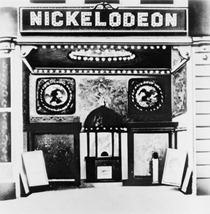
At first everyone thought films were a novelty.   Early distribution forced the theatre owners to buy the prints of films they were showing.  This didn’t work out well for the exhibitors.  As a result, it wasn’t a good business proposition to show a film. 

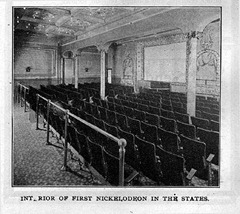
In 1903 the Miles brothers from San Francisco established the modern form of distribution by setting up the first film exchange.   They bought the prints and leased them to exhibitors at a much lower cost than buying the film outright. As a result film became an economical win for everyone involved.  This caught on rapidly. Nickelodeons sprang up all over the world and it was apparent film was here to stay.  

Exterior Nickelodeon Interior Nickelodeon

People became hungry for new films, regardless of quality, and studios churned them out.  As a result film didn’t change all that much. Between 1903 and 1912 there aren’t many noteworthy creative achievements or experiments – except for a few shorts by D.W.Griffith.  What did change was the amount of film which could be produced.

Early Film setOriginally all film had to be shot with sunlight. This meant that films could only be shot in good weather.  However, with the invention of the mercury vapour lamp several film companies were able to build indoor studios and thereby increase their production.   Still most studios shot outside, and all shot on very low budgets with no retakes of scenes.  Most filmmakers believed what they were doing was grinding out cheap entertainment, and they were.

But even if the filmmakers weren’t taking movies seriously, other groups were.  Once the Nickelodeons sprung up and organised religion and the political right realised movies weren’t going away, they mounted campaigns to suppress them. Between 1907 and 1909 it became commonplace for minsters, politicians and business to be against the movie industry.  Today it’s thought these campaigns were more economically than morally minded because people were frequenting  Nickelodeons and spending their money there rather than at churches, saloons, and vaudeville theatres.

Another issue facing the early industry was piracy. There were no copyright law for “living pictures”.  Exhibitors pirated copies of the films and showed them.  Worse, since the equipment was patented and a fee was expected by those who used it, production companies were pirating equipment.  Anything produced by that pirated equipment was considered the property of the production company that made it.   So even the laws that did govern the industry were difficult to enforce.

In 1909, Edison and a group of patent holders created the MPPC (The Motion Pictures Patent Company) – a trust (a polite word for monopoly) that would try to control the film industry.  Joining the trust was Eastman Kodak, the largest producer of film stock.  The MPPC controlled who got equipment, who got film stock and who got distributed – at least in the United States.

What held film back, at least in the US, was that the MPPC believed film audiences had a short attention span.  Therefore they would only supply one reel of film per week to member companies and they would only distribute films of that length.  So because of the MPPC,  audiences in the US were watching epic plays like King Lear or novels like Frankenstein boiled down to under 15 minutes.

However, the feature film was about to be born. In the US filmmakers like D.W. Griffith tried to distribute two reel films, one reel each week - which didn't work because of continuity issues.  But, in other parts of the world filmmakers started making longer films and despite what Edison might have thought, the longer films captured the audience's attention.

Next article The Birth of an Art Form

Previous article A Shot in the Narrative

First article Before Film

Saturday, September 17, 2011

A Shot in the Narrative

The shot is more than just a close-up.  It is an integral part of what film is today.  A film is a series of shots put together through editing to fictionalize an event - to tell the tale of it. 

Méliès had discovered that two different pieces of film can be put together to create the illusion of something which couldn’t possibly happen.  Now it was time to use that knowledge to create the illusion that something was happening.  Something real.  

The two discoveries that were made which made narrative film possible were the close-up and parallel editing.  

The close-up was cut into  Méliès tableaus in order to bring the viewer closer to a specific action.  To show them detail  of the action happening while it happens. 

Parallel editing was editing two different simultaneous lines of action together into one line of action.

Firemen spray the exterior of a building.  Inside a baby cries as flames near its crib. Outside a fireman climbs a creaky ladder.   Inside a mother tries to cross a line of fire to reach her baby. 

Around the same time that Méliès was active in France a couple of English gentlemen from Brighton were experimenting with both of these concept -- George Albert Smith and James Williamson.

James Williamson was supposedly the discoverer of parallel editing.  I say supposedly because the films I’ve found don’t seem to match up with the history I’ve read.  Plus the history even says many of these early films don’t exist in their original shape.  Take for example this film:

It’s supposed to contain examples of parallel editing but I just don’t see them.  If you happen to find a copy of this film or  Stop Thief or Attack on a China Mission that contain good examples of parallel editing or if you happen to see it in this film then please let me know.

Funnily enough  while searching through the web, I discovered Williamson’s most popular films today seem to be the following.

The second film, The Big Swallow, claims to be the first close-up.  

However, historically the discoverer of the close-up is considered to be George Albert Smith (our other English gentleman).  And the first example of a close-up I can find from him is in this film from 1900.  So it seems that maybe he actually is.

Other films from G. A. Smith that are of interest are the first Christmas film from 1898. You can see the Méliès influence in this one.

And also this tragically funny film from 1903 called Mary Jane’s Mishap.  That’s Smith’s wife in the lead.

And last but not least I made an error in the Méliès post and attributed this film to him.  It’s actually Smith’s film. Méliès made a film of the same name a year earlier – proof of the competition that early filmmakers faced and that they had good knowledge of their competitors. 

Then in steps Edwin Porter a projectionist for the Edison company until he became a director in his own right.  He started out directing a few actualitiés then, after picking up on the narrative advances of Méliès, Smith and Williamson, directed the first true narrative film, The Life of an American Fireman. 

I found this copy of the film which has subtitled information on the important narrative structure (Thanks to Ashley Hughes). This film has no sound so crank up your tunes.

Life of an American Fireman Narrative Structure from Ashley Hughes on Vimeo.

However, there is some controversy about this being the first narrative film because two copies exist.  One with parallel editing and one without.  No one is certain which came first and the second may have come much later than the first.

So the first indisputable narrative film is the Great Train Robbery. 

However, even that film has it’s controversy.  Many believe it was “borrowed” from this earlier British film.

Either way the shot and narrative film were out of the bottle and there was no putting them back.  The way was paved, the structure in place, for the upcoming great silent directors like D.W. Griffith.

Next article The Birth of an Industry

Previous article The First Narrative Films

First article Before Film

Monday, September 27, 2010

Oil Spill Movies

Gulf-Coast-Photo-Gallery-17 Being that there has been so much news of late about oil spills, due to the big BP one in the gulf which has itself strangely disappeared from the news.    I started to think it might be a good time to write a script about an oil spill.  I began to wonder how many movies there were about oil spills and to my surprise I couldn't think of one...well maybe one.  I vaguely remembered a TV movie about the Exxon Valdez from eons ago. 


I did a keyword search on IMDB and came up with 21 matches, of the 21 most were doccos.  Two were  video games, one  called Metal Gear Solid 2: Sons of Liberty and the other called James Pond: Underwater Agent.  There were two TV episodes, one from Johnny Bravo: Endless Bummer/Jailbird Johnny/Bravo 13 and  Rescue 8 (1958 TV series): The Chasm

On the movie side of things there was a French movie called  Le diable probablement whose synopsis didn't say a word about oil and ended with the word suicide.  Charming. There was  Dead Ahead: The Exxon Valdez Disaster  which was that TV movie I vaguely remembered.  There was a DTV The 7 Adventures of Sinbad. Next...

The big features were Free Willy 2: The Adventure Home and On Deadly Ground, the first being an improbable story about a killer whale's friendship with a young boy (but if you ask me Willy's just waiting for his morsel to ripen).  And the second is Steven Seagal's most highly acclaimed work - 'nuff said.

And wait, I also found mention that there was a prophetic oil spill in the film Knowing.

Who would have known?

I was certain there were more. Phantoms, from the Dean Koontz novel of the same name, but that creature is only an oil-like substance, not a spill.  Godzilla vs. The Smog Monster?  I think the smog monster is just sludge and while sludge can be oil I don’t think that was the intention of the movie – nor is there an oil spill in it.

So there is a dearth of oil spill movies that aren't doccos.  It would seem to me that SyFy channel who just released Sharktopus could have a field day with the subject.  Or maybe I shouldn’t be giving them any ideas. 

So, forget SyFy, maybe we should all write a script about oil spills.  The news about them might be dying right now but there's always the next one.

What?  You didn't think there was going to be an next one?

Saturday, September 25, 2010

A Nightmare on Elm Street

I noticed while surfing that the remake of this film was getting lots of attention.  I’m still wondering why, I guess it was just released on DVD.  However, I did find out an interesting tid-bit while investigating this.

But before I go into that I would like to say that I loved the initial trilogy of Nightmare films.  Before they got too full of their own franchise.

They were cutting-edge (see what I did there) horror for their time and they introduced us to a number of actors we would see much later.  Johnny Depp (before he was nicknamed Stinky) and  Patricia Arquette.

I recently watched the first one again and it holds up – even after all these years.  That is film-making.

I haven’t seen the remake but it looks good.

I can already tell from the trailer that there are plot holes.  The original didn’t dwell on this as much as the new movie promises but if Freddy Krueger went after little kids while he was alive, why is he going after late teens now?  Wouldn’t it make much more sense if the people having the nightmares were younger?

Plus this film seems to take itself far too seriously.  That’s usually a recipe for disaster in just about any horror film.  They’ve thrown out all of Freddy’s one-liners when they replaced Robert Englund with Jackie Earle Haley

The reviews for this film seem pretty much to agree.  This is the same type of remake as Halloween was.  The same sort of thing as Batman Begins where we find out a bit more about what makes our hero or villain tick.  Where the film-maker tries to make them more human or less.   

The reviews also suggest that the effects, however primitive, worked better in the first film.

The interesting tid-bit I found out was the Wes Craven was not pleased about them remaking the film because he wasn’t consulted about it.  I would be a bit ticked off too.

If you’ve seen this film, let me know what you thought. 

Friday, September 24, 2010

The Social Network

A subject we all have come to know and love, Facebook.  It’s founder Mark Zuckerberg the protagonist in the film.   Here’s the official trailer.

It’s out but I haven’t seen it yet.  Though from the reviews it sounds a bit odd.  It is often compared to classics like Macbeth or The Great Gatsby.  Most agree it is not a flattering portrait of Zuckerberg.   Even he wants to distance himself from it.

Because I haven’t seen it I won’t go into a review here but will instead link you to a couple I’ve found. This one is from the Geeks of Doom  and here is one from Screen Rant

Being that it was directed by David Fincher, who was also responsible for Se7en, Fight Club, Zodiac, and Curious Case of Benjamin Button – it’s likely this will be an excellent movie. 

My biggest question is, after I see this film will I feel differently about using Facebook?

Harry Potter and the Deathly Hallows Trailer

Ok well, it isn’t exactly about screenwriting but HP was a very successful franchise.  I, for one, will be happy to see it finish up.  And from the trailer it looks like it will go out with a bang.

The interesting thing is they are going to show this movie in two parts, according to the trailer.  I’m pretty certain that has been tried before, but I can’t remember the movie name and I’m pretty sure it was a failure.  Hopefully, this will be a bit better. 

The other is that it will be in 3D, big surprise (that was sarcastic) but It probably was not shot for it.

This is my least favourite of the books however, it has a fun though predictable ending.  I suspect the movie will do well.     

Sunday, January 18, 2009

Logan's Run Remake

image Last night I had a Logan's Run double feature, I watched the movie and I read what I think is one of the screenplays for the remake in 2010 (it didn't have the correct name attached but it felt right). What did I think? And I'm going to try and do this without any real spoilers.

Well first we should refresh our memory on the 1976 version. Logan our sandman protagonist encounters a runner that has a special symbol around his neck. The controlling computer sends him on a mission to seek out Sanctuary. He follows up some leads most notably Jessica who he found on the sex circuit. With her reluctant, at first, help he sets out to find Sanctuary and meet those that help the runners find it. They end up in a ruined earth and meet an old man and his cats. Logan transforms he is no longer the sandman seeking Sanctuary, he has been freed. After killing Francis, the antagonist (or at least his helper) he goes back to free everyone.

image A long time ago I read the book Logan's Run. I don't remember many of the details but I do remember it was very different from the movie. The new screenplay for Logan's Run is not as different from the original movie (it is obviously inspired by the movie not the book) but at the same time it's radically different. I liked it but at the same time I missed some of the stuff that was removed.

I guess I could tell you what was removed, technically that isn't a spoiler. You won't see any of the following in the remake.

No Box, they don't meet on the circuit, no romance, and no old man and his cats.

As a matter of fact, the new script has changed so much that some of the characters have even switched sides. Plus there is the introduction of new characters that must be there to offset the removal and changes in the old characters. The biggest change is the location, the remake happens in space. Yes, in space. And the habitat has cats.

This next section doesn't really tell you anything specific about the script but does include my interpretation of how the three main characters have changed. Logan in my opinion is not the protagonist in this script, he is a main character but he does not undergo a transformation and his goal never changes. For this matter, I don't really think Jessica's undergoes a transformation either but I think she is more likely as the protagonist. Francis does undergo a transformation in this script, he goes from antagonist's helper to protagonist's helper during the course of the story. This is one of the biggest changes in the remake and is offset by a newly introduced sandman character.

The remake relies much more on plot than the original did and it also has much more fast paced action. It has a pretty solid structure and in my opinion it is a much better script than the original. I'm looking forward to seeing the remake when it comes out, even though they'll probably muck things up a bit during production.

Godzilla vs the Smog Monster

Started my new job yesterday, we won't go into what I do there because I promised this blog would not contain technical stuff. At the moment I'm a bit bored and unhappy with all the reading I've been doing. Things should improve though.

image Tonight as I type this, I'm watching Godzilla vs the Smog Monster (Gojira tai Hedorâ). This is my favourite Godzilla movie. Besides the swinging 60s feel and message. This one even has some animation it. It's loads of fun and Godzilla even gets to be a hero during it. You didn't know Godzilla was interested in the environment did you? I probably will long be done with this blog entry before it's over. I wish I could find the discotheque scene on You Tube but no dice. Here's a couple of snippets of it anyway.

Sunday Night at the Movies

Last night I was just about to add a post to my blog when I accidentally deleted it. I felt like such an idiot. Here is what I remember from that post along with some extra. Had a bit of a movie night on Sunday.

imageIf you've been following my blog, you know that I needed to watch The Strangers because we are doing the script very soon with the Script Club from Simply Scripts. So I watched it. It was a similar sort of movie as Halloween and even borrowed some imagery from the movie, a masked killer sort of thing. It managed to keep an adequate amount of tension throughout, while trying to deliver a bit more character than usual. This would have worked well, but the acting by Liv Tyler and Scott Speedman was pretty average.

I'm not saying I didn't like the movie, but I thought it could have been better than it was. I had a couple of issues with the story itself. First of all they never quite explain why there is so much drama between the young couple at the beginning of the film. They sort of explain what happened to cause the struggle but they never fully explain her reasons. Trying to be oblique and artsy in a movie where that sort of thing clearly does not belong.

The other thing was that I had a believability problem with the killers. Toward the end of the movie they make it pretty clear that they haven't done this killing thing very often - or at least one of them hasn't. Yet for some reason they are able to appear and disappear with such mastery while they terrorise the young couple and they never make a mistake once. Never get seen when they aren't supposed to be seen, never get clumsy, never have any problem at all with their reign of terror. This to me was unrealistic.

Lastly, this movie really didn't scare me much. If I lived in a remote location and was home alone then I probably would have been terrified. But my neighbours are very close and this sort of thing didn't strike me as something that would easily happen here, so it really didn't bother me. I'm sure I'm not the only one that is going to feel that way about it.

image Earlier in the evening I watched Fracture. This was a fairly run of the mill but well-written thriller, a courtroom/catch the killer at his game sort of movie. The pacing was good and the story interesting enough. It was recommended to me by the girl at the video rental place because she likes Anthony Hopkins. And she must really like Anthony because his performance, to me, seemed like he was pretty much going through the motions. Whether that really affected the movie all that much is up to how much you like Anthony.

The other performances Ryan Gosling and Billy Burke were quite good. It didn't knock my socks off like The Illusionist did but then again I'm not even sure why I keep comparing the two in my head. They were vastly different movies.

The best part about this was the DVD because it had alternate endings. I watched both. I liked the one they actually used the best.

Anyway, that's it for me. Tomorrow I start a new job and I have lots I want to do before I head off to bed tonight. Will I get it done? Probably not but I give it a try anyway.

Back to work

Today was my first day back to work after the long holiday. I'm feeling surprisingly good after the workday - perhaps it was that afternoon cup of coffee. To be honest it made me shaky when I first drank it, now it seems to have mellowed.

The Script Club at Simply Scripts has almost decided to review The Strangers by Bryan Bertino. It should be interesting once we start - which should be in a few weeks. You should drop by and have a gander at what we say about the script. This time we should mostly have watched the film and should have an entirely different spin on our script review. We should cover what has been dropped from the film and what has been added (if anything). I'll provide a link once we start.

The other thing happening over at Simply scripts is the Shiva game. It's a screenwriters game but we are trying to produce a writable script using the technique. I'm trying to inject a bit more story into the game script. I was trying not to have to write too much of the story beforehand, but it looks like that is not working. The next time we do this we will have to include more of a treatment.

That's about it for tonight. Working on a webpage but I won't talk about that in this blog. In the background Star Trek TOS is playing in the background. The episode where Spock goes Amok. Love that word.