Showing posts with label actualités. Show all posts

Saturday, October 22, 2011

Caligari’s Cabinet

Let’s take a dark journey, one that brings us to pre-war Germany, before the first World War.   The German’s have not taken to creating their own cinema – they would rather import it.

That is with the exception of Oskar Messter who produced a number actualités and other films from 1866 onwards. 

Oskar Messter and Carl Froelich

In 1909 he collaborated (which he often did) with Carl Froelich on Germany’s first feature, Andreas Hofer.  

Unfortunately I can’t find any of these films online.   I did find what is may be an earlier collaboration between the two but be warned there’s full-frontal nudity, male and female, in this “film”.


1903 - Akt-Skulpturen. by cityangelo

What was most important about this duo is that they were one of the first to use artificial lighting for their movies and they preferred it.   Also an number of film stars that would surface in later years, like Conrad Veidt, got their start at Messter’s studio. 

Also on the list of films I can’t find online is what happened in 1912.  Germany was inspired by France’s film d’art to make their own Autorenfilm (famous author’s film).   

These films were mostly direct adaptations of stageplays, like Der Andere(The Other One) by Max Mack, The Isle of the Dead by Max Reinhardt and Das Fremde Mädchen(The Strange Girl) by Hofmannsthal – the first German film to seriously express a supernatural theme.   Their importance is in establishing the German film industry.

The first film to hint at Expressionism was Der Student of Prague(The Student of Prague – 1913).   I couldn’t find an online copy of this version of the movie but I did find this trailer.

Expressionism is the film movement concerned with “deep and fearful concerns about oneself” that dominated the German cinema until the early thirties.  It’s a cinema of dark stories, lighting and moods.  We owe much of our modern horror to this film movement, just like The Cabinet of Dr. Caligari owes much of itself to The Student of Prague.  

Other pre-Expressionism films were Der Golem(The Golem) co-directed by Galeen, the screenwriter, and Wegener, the star actor of The Student of Prague.  No surviving print here so this video is all that exists.

In 1920, after the war, the same team (Galeen and Wegener) remade this film – here is that version.

The other film was Homunculus(1916) by Otto Ripper.  This film was the most popular film in war time Germany.  It was episodic - released in six parts.  It also features a Golem-like creature, an intelligent artificial being that has no soul.  Unfortunately I can’t find an online version of this video so this picture will have to do you.  

Homunculus

The Student of Prague, The Golem and Homunculus laid all the necessary groundwork for Expressionism to flourish in German cinema. However…

In 1917 the German’s put the entire film industry under state control.  The organization was called the UFA (Universem Film Aktiengesellschaft) and yes that was an attempt to stem the tide of anti-German propaganda.  Not much to talk about here, really.

But after the war, in 1918, the German government resold their shares in the UFA to private organizations.  Expressionism was ready to blossom (what, you expect something cheery when their country just lost a war).

The first Expressionist film was Das Kabinett Des Dr. Caligari(The Cabinet of Dr. Caligari –1919) by Hans Janowitz and Carl Mayer. It took a year for the film to get made because no producers wanted to make it.  Here is that film in its entirety.

Caligari has everything one needs for Expressionism - shadows, moods and madness (for a detailed explanation of the film techniques used see this blog).   

There’s a bit of a debate as to which of these films is the first true horror film.  Most people tend to say Caligari, however there’s a growing trend naming The Student of Prague as the first.  Plus no one can argue that The Golem is the first monster movie.  

But the first Golem hasn’t survived and neither has Student (based on my research). So that would make Caligari the first surviving example of both.  There, that answer should make both sides happy.

More Expressionism to come but first there’s going to be a Revolution in Russia.

Next article The Russian Revolution

Previous article The Birth of a Nation

First article Before Film

Saturday, September 17, 2011

A Shot in the Narrative

The shot is more than just a close-up.  It is an integral part of what film is today.  A film is a series of shots put together through editing to fictionalize an event - to tell the tale of it. 

Méliès had discovered that two different pieces of film can be put together to create the illusion of something which couldn’t possibly happen.  Now it was time to use that knowledge to create the illusion that something was happening.  Something real.  

The two discoveries that were made which made narrative film possible were the close-up and parallel editing.  

The close-up was cut into  Méliès tableaus in order to bring the viewer closer to a specific action.  To show them detail  of the action happening while it happens. 

Parallel editing was editing two different simultaneous lines of action together into one line of action.

Firemen spray the exterior of a building.  Inside a baby cries as flames near its crib. Outside a fireman climbs a creaky ladder.   Inside a mother tries to cross a line of fire to reach her baby. 

Around the same time that Méliès was active in France a couple of English gentlemen from Brighton were experimenting with both of these concept -- George Albert Smith and James Williamson.

James Williamson was supposedly the discoverer of parallel editing.  I say supposedly because the films I’ve found don’t seem to match up with the history I’ve read.  Plus the history even says many of these early films don’t exist in their original shape.  Take for example this film:

It’s supposed to contain examples of parallel editing but I just don’t see them.  If you happen to find a copy of this film or  Stop Thief or Attack on a China Mission that contain good examples of parallel editing or if you happen to see it in this film then please let me know.

Funnily enough  while searching through the web, I discovered Williamson’s most popular films today seem to be the following.

The second film, The Big Swallow, claims to be the first close-up.  

However, historically the discoverer of the close-up is considered to be George Albert Smith (our other English gentleman).  And the first example of a close-up I can find from him is in this film from 1900.  So it seems that maybe he actually is.

Other films from G. A. Smith that are of interest are the first Christmas film from 1898. You can see the Méliès influence in this one.

And also this tragically funny film from 1903 called Mary Jane’s Mishap.  That’s Smith’s wife in the lead.

And last but not least I made an error in the Méliès post and attributed this film to him.  It’s actually Smith’s film. Méliès made a film of the same name a year earlier – proof of the competition that early filmmakers faced and that they had good knowledge of their competitors. 

Then in steps Edwin Porter a projectionist for the Edison company until he became a director in his own right.  He started out directing a few actualitiés then, after picking up on the narrative advances of Méliès, Smith and Williamson, directed the first true narrative film, The Life of an American Fireman. 

I found this copy of the film which has subtitled information on the important narrative structure (Thanks to Ashley Hughes). This film has no sound so crank up your tunes.

Life of an American Fireman Narrative Structure from Ashley Hughes on Vimeo.

However, there is some controversy about this being the first narrative film because two copies exist.  One with parallel editing and one without.  No one is certain which came first and the second may have come much later than the first.

So the first indisputable narrative film is the Great Train Robbery. 

However, even that film has it’s controversy.  Many believe it was “borrowed” from this earlier British film.

Either way the shot and narrative film were out of the bottle and there was no putting them back.  The way was paved, the structure in place, for the upcoming great silent directors like D.W. Griffith.

Next article The Birth of an Industry

Previous article The First Narrative Films

First article Before Film

Friday, September 9, 2011

The first narrative films

Up until around 1896 all films were recordings of real time events.  Some may have told limited stories but ultimately they were the equivalent of sketches or stage acts.

The man credited with discovering the potential of film as a narrative device (and also it’s potential for trickery) was Georges Méliès.  The story goes that  Méliès  while filming an actualitié, he was filming a bus coming out of a tunnel and the film jammed.  When he got the film started again the bus had been replaced by a hearse.  When the film was projected it seemed like the bus had transformed into a hearse.  Nothing like having the first epiphany about the power of film editing.

As the father of special effects George Méliès made use of what he had learned.

He was the first to put editing to narrative use though, because he thought of his films in terms of theatre, as a series of tableaus which he edited together.

He also made extensive use of tinting. He had a shop full of ladies that hand tinted his films. He is probably best remembered for his masterpiece Le Voyage Dans La Lune (Voyage to the Moon).  The first sci-fi film.

You can watch the complete film here.  Méliès went on to make many other films until he was put out of business by Pathé Frères in 1923. Hand tinting was expensive.

Unfortunately Méliès never quite went beyond the use of his discovery for trickery or scene changes. To discover a “shot” it would take a light bulb moment from a projectionist named Edwin S Porter who worked for Edison Corporation in New York.

Next article A Shot in the Narrative

Previous article The Earliest Films

First article Before Film

Saturday, September 3, 2011

The Earliest Films

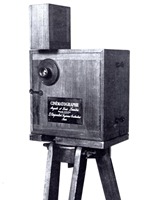
The earliest films were non-narrative documents of mundane events or entertainment acts.  The competing companies where those that had projectors.  In the US, Edison Company had the Kinetoscope.  In France, the Lumière Brothers had the Cinematograph.  And in England, Charles Jenkins had the Phantoscope (which was the first machine to project a motion picture).

Cinematograph detail_12_clip_image023[1]

There earliest known surviving celluloid film was shot by by Louis Le Prince on October 14, 1888 in Roundhay, Leeds, West Yorkshire, England.

Edison Company produced many short films using the Kinetograph, the most famous of which (for some reason or other) was Fred Ott’s Sneeze (1894).  This was considered a documentary.

However, the sneeze wasn’t the earliest.  The earliest by Edison that I could find was Dickson’s Greeting (1891).  Dickson invented the Kinetograph technology for Edison.

Other Edison films were entertainment acts.  Edison Co were trying to make money after all and the best way to do that was to entertain.  Here’s a compilation of some early Edison films for your enjoyment.

The Lumière Brothers were also interested in cashing in on this new medium with their actualités.  Here’s a compilation of their films for your enjoyment.

But most of these short films were for the Nickelodeon arcade traffic.  Soon, films would become longer and they would start to tell stories. 

Next article The First Narrative Films

Previous article Before Film